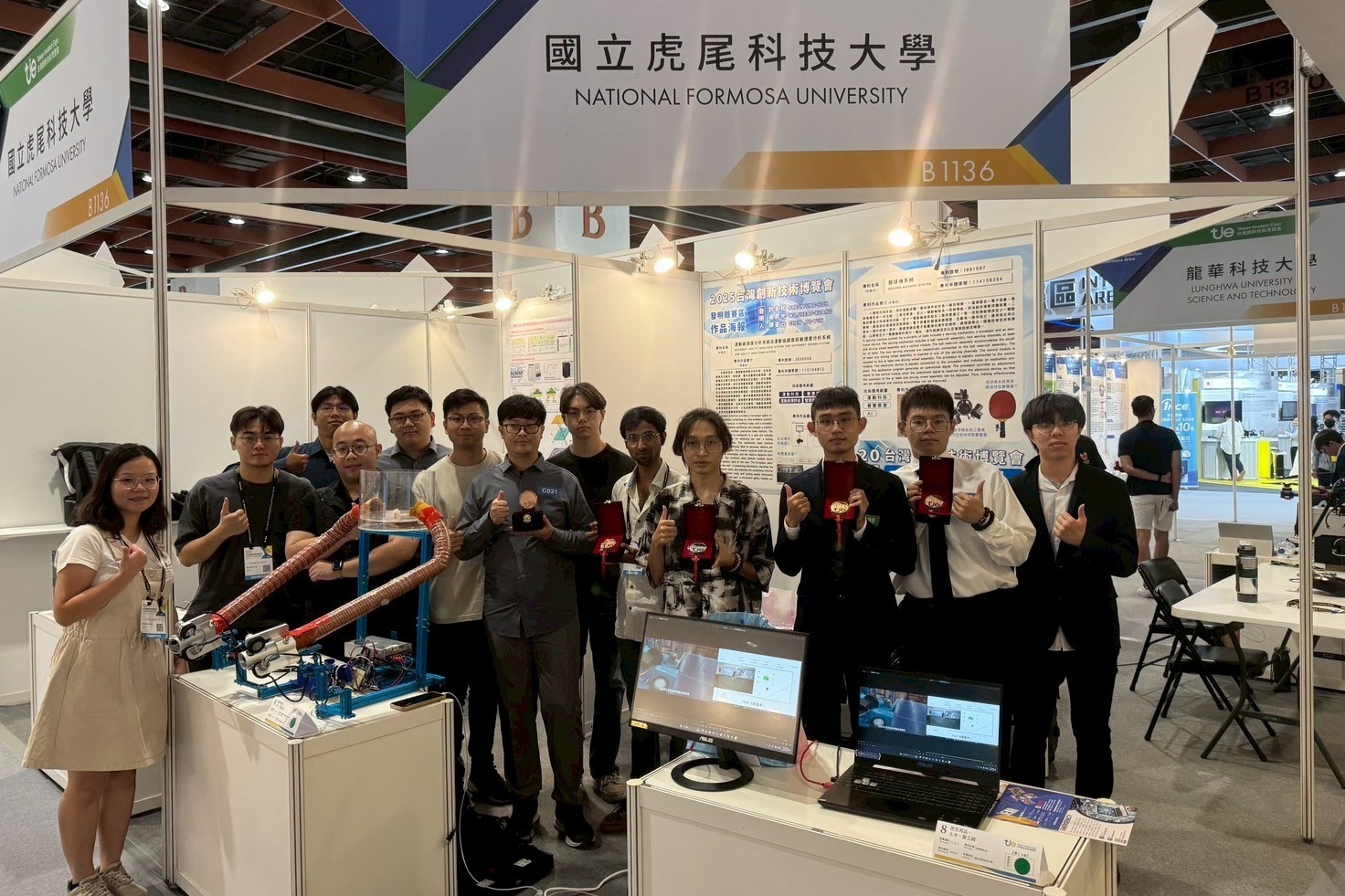
The award ceremony for the 2025 Taiwan Innovative Technology Exposition Invention Competition was held on Saturday, October 18. National Formosa University (NFU) stood out among 554 submitted patents, winning 1 gold, 1 silver, and 3 bronze awards, showcasing the university’s integrated strengths in smart technology, engineering applications, and biomedical detection.
The exposition was jointly organized by 11 government agencies, including the Ministry of Economic Affairs, National Science and Technology Council, Ministry of Agriculture, Ministry of National Defense, Ministry of Education, Ministry of Labor, Ministry of Health and Welfare, Environmental Protection Administration, Digital Development Agency, National Development Council, and Academia Sinica. The event featured the latest domestic and international innovations and products, promoting industry-academia exchanges, international cooperation, and opportunities for intellectual property and technology investment.
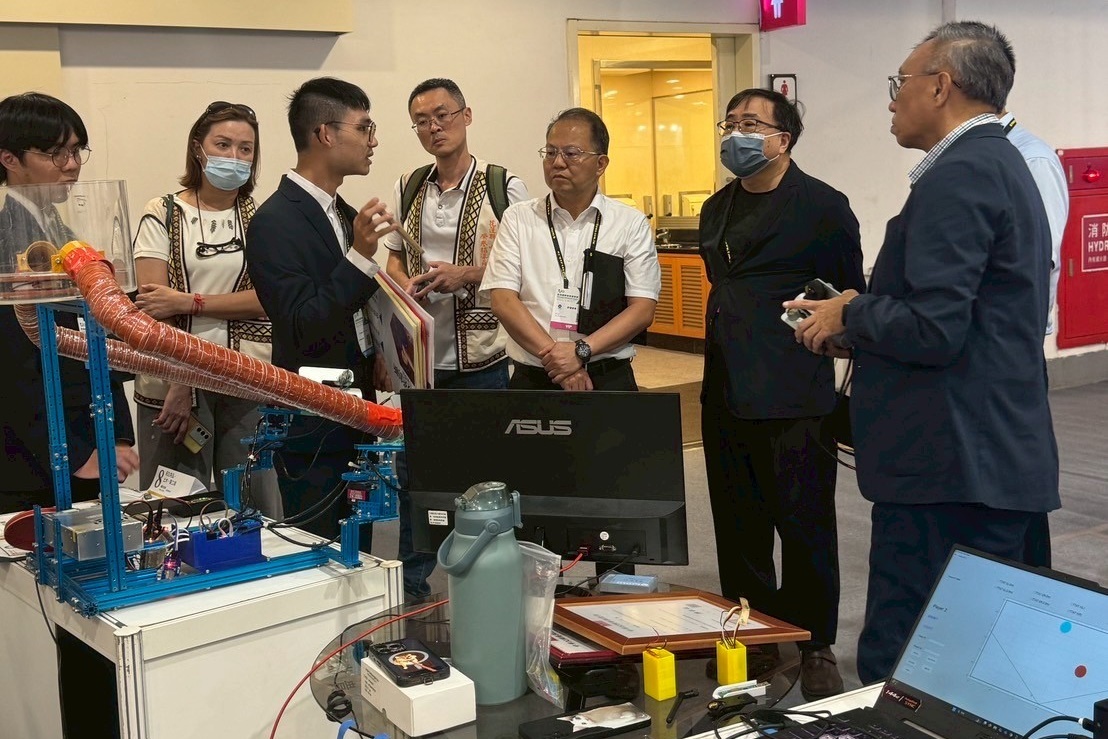
NFU won the gold medal with the “Ball Serving Machine System,” developed under the guidance of Distinguished Professor Xu Yong-He of the Department of Computer Science and Information Engineering, Professor Chen Zi-Yun from the Sports Office, and Professor Wu Sheng-Guang of National Taiwan University of Sport, together with students Guo Guan-Tai, Chen Yi-Xuan, and Huang Xu-Sheng. The system uses electronic control and intelligent sensing technologies to automatically adjust ball speed and direction according to training needs, greatly improving table tennis training efficiency and fluidity.
The silver medal-winning project, “Detection Device and Manufacturing Method of Its Resonant Detector,” was developed by Professor Guo Wen-Kai of the Department of Photonics Engineering and students Chen Yan-Ting and Chen Guan-Lin. The technology uses resonant sensing components to detect refractive index changes caused by biomolecules, potentially replacing conventional enzyme immunoassay techniques. It allows detection using low-cost, compact imaging sensors, offering strong market advantages.
One bronze medal project, “Mechanical Hand with Simulated Finger Structure,” was jointly developed by a cross-disciplinary team including Zhang Zhen-Yuan, Director of the Mechanical and Mechatronics Research Institute at ITRI and former NFU Vice President, Professors Xu Kun-Ming, Zheng Fang-Song, Xiao Jun-Qing, and Associate Professor Li Meng-Hua, along with students Zheng Bo-Hong, Chen Hong-Ming, and Zeng Hong-Wen. The project features a self-designed finger skeleton, stainless steel bead chains, and servo motors to simulate human muscle contraction, with ceramic piezoelectric elements in the fingertips for tactile feedback, enabling more natural and sensitive operation suitable for automated tasks like fruit harvesting and handling fragile industrial items.
The other two bronze medal projects are “Sports Agility Analysis System and Coordination & Agility Analysis System” and “Mobile Vehicle Performance Analysis System and Method.” The former, developed by Distinguished Professor Xu Yong-He, Professor Chen Zi-Yun, and Professor Wu Sheng-Guang, integrates ultra-wideband positioning, millimeter-wave radar, and motion sensing to analyze user trajectories and speeds in real time for agility and coordination assessment. The latter, developed by Associate Professor Zhan Zi-Qi of the Department of Mechanical and Computer-Aided Engineering and student Huang Sheng-Lun, uses vibration sensing and data analysis to detect anomalies in unmanned vehicles or motor vehicles early, enhancing maintenance efficiency and driving safety.
NFU’s participation was coordinated by the Office of Research and Development and supported by the Higher Education Sprout Project. The university plans to continue integrating cross-disciplinary resources to support faculty and students in innovative research.
Text and photos provided by: Office of Research and Development