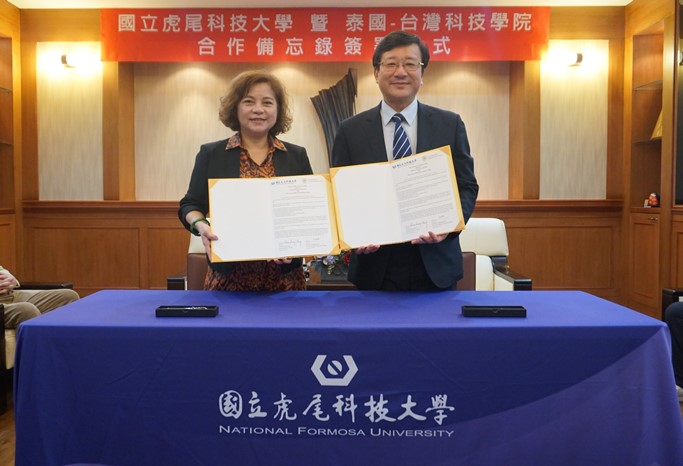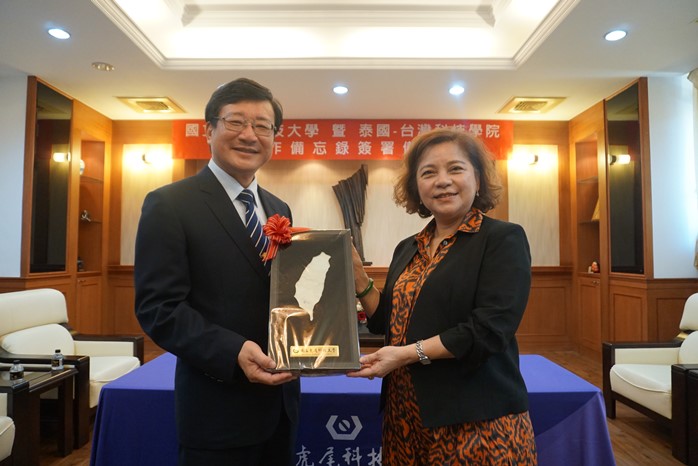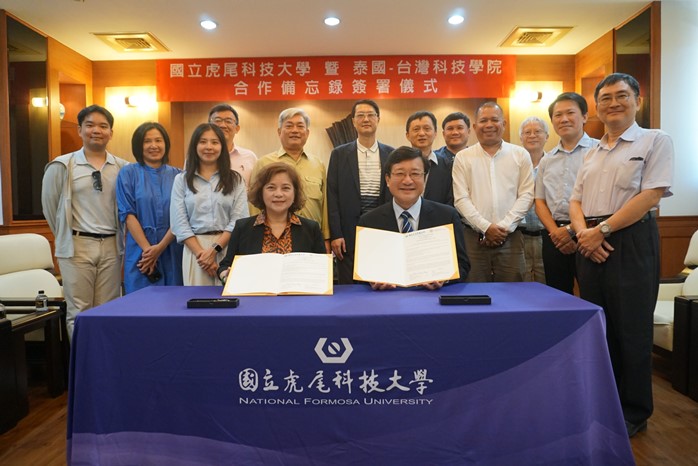
National Formosa University (NFU) is actively promoting educational internationalization and talent cultivation for the New Southbound Policy. Today (14th), the university officially signed a Memorandum of Understanding (MOU) with the Thai-Taiwan BDI Technological College, represented by NFU President Chang Shing-Liang and BDI Technological College Chairperson Lin-Chin Chang. The two parties will work together to promote an integrated plan for Chinese language education and vocational training, jointly cultivating bilingual talents with both language proficiency and professional skills, thus deepening a new chapter in Taiwan-Thailand educational cooperation. According to the cooperation content, over the next five years, both sides will facilitate curriculum integration, faculty exchange, and Chinese language training to help Thai students strengthen their Chinese foundation before coming to Taiwan to study professional courses. This will shorten their language adaptation period and enhance learning and internship effectiveness, establishing a talent cultivation chain of "language first, vocation alongside."
President Chang Shing-Liang stated that NFU has long been committed to promoting the "international linking of vocational education," aiming for a dual-axis approach of "language communication + technical practical skills." This collaboration not only helps Thai students enter Taiwan's higher education system using Chinese as a bridge but also allows Taiwan to better grasp the pulse of Thailand's industrial development, injecting new energy into the New Southbound education layout. He emphasized: "Language is the starting point for understanding culture, and technology is the power to co-create the future. NFU is willing to be the key gateway for Thai youth to connect with Taiwan and the world."
Lin-Chin Chang, Chairperson of the BDI Technological College, stated that the college is the only vocational institute in Thailand founded by local Taiwanese businesspeople, offering senior high and junior college programs. The senior high program includes an auto parts manufacturing department, while the junior college covers fields such as molds, electrical engineering, accounting, e-commerce, and electric vehicles. The college has long introduced Taiwan's "industry-academia cooperation" model, combining theory with practice to cultivate professional talents who can immediately contribute to production lines. She pointed out: "This collaboration with NFU is not just an educational exchange, but a two-way linkage of industries and cultures between the two countries, allowing more Thai youths to use Chinese as a starting point and technology as a bridge to open up a broader future stage."
Lin-Chin Chang also serves as the chairperson of the Thai-Taiwan Association and this year won the "Overseas Community Affairs Contribution Award" for Global Outstanding Overseas Chinese Alumni. She has long cultivated Taiwan-Thailand educational and industrial cooperation and is dedicated to promoting media and cultural communication projects. Recently, she founded the Thai-Taiwan Times, adhering to the philosophy of "every character in traditional Chinese, every sentence with sincere heart," to convey Taiwan's cultural spirit and values to Thai society. She emphasized: "Education and media are actually the same force—both are ways for people to understand the world and connect with each other. Through text and education running in parallel, we hope to extend Taiwan's warmth in Thailand."
NFU indicated that the school particularly emphasizes foreign students' integrated Chinese language and professional training, allowing foreign students in Taiwan to simultaneously enhance their Chinese and technical communication abilities, becoming bilingual vocational talents who "understand the language, understand the technology, and understand the culture." This move not only responds to the demand from Taiwanese enterprises in Thailand for Chinese-speaking technical talent but also highlights Taiwan's international educational influence and cultural soft power.
This collaboration not only lays the foundation for the two schools to jointly cultivate New Southbound talents but also symbolizes that Taiwan-Thailand educational exchange is entering a new stage. In the future, both parties will adopt a three-pronged strategy of education, industry-academia collaboration, and culture to jointly cultivate a new generation of international professional talents, opening a new chapter for Taiwan-Thailand friendship and cooperation.
Provided by: Secretariat
President Chang Shing-Liang stated that NFU has long been committed to promoting the "international linking of vocational education," aiming for a dual-axis approach of "language communication + technical practical skills." This collaboration not only helps Thai students enter Taiwan's higher education system using Chinese as a bridge but also allows Taiwan to better grasp the pulse of Thailand's industrial development, injecting new energy into the New Southbound education layout. He emphasized: "Language is the starting point for understanding culture, and technology is the power to co-create the future. NFU is willing to be the key gateway for Thai youth to connect with Taiwan and the world."
Lin-Chin Chang, Chairperson of the BDI Technological College, stated that the college is the only vocational institute in Thailand founded by local Taiwanese businesspeople, offering senior high and junior college programs. The senior high program includes an auto parts manufacturing department, while the junior college covers fields such as molds, electrical engineering, accounting, e-commerce, and electric vehicles. The college has long introduced Taiwan's "industry-academia cooperation" model, combining theory with practice to cultivate professional talents who can immediately contribute to production lines. She pointed out: "This collaboration with NFU is not just an educational exchange, but a two-way linkage of industries and cultures between the two countries, allowing more Thai youths to use Chinese as a starting point and technology as a bridge to open up a broader future stage."
Lin-Chin Chang also serves as the chairperson of the Thai-Taiwan Association and this year won the "Overseas Community Affairs Contribution Award" for Global Outstanding Overseas Chinese Alumni. She has long cultivated Taiwan-Thailand educational and industrial cooperation and is dedicated to promoting media and cultural communication projects. Recently, she founded the Thai-Taiwan Times, adhering to the philosophy of "every character in traditional Chinese, every sentence with sincere heart," to convey Taiwan's cultural spirit and values to Thai society. She emphasized: "Education and media are actually the same force—both are ways for people to understand the world and connect with each other. Through text and education running in parallel, we hope to extend Taiwan's warmth in Thailand."
NFU indicated that the school particularly emphasizes foreign students' integrated Chinese language and professional training, allowing foreign students in Taiwan to simultaneously enhance their Chinese and technical communication abilities, becoming bilingual vocational talents who "understand the language, understand the technology, and understand the culture." This move not only responds to the demand from Taiwanese enterprises in Thailand for Chinese-speaking technical talent but also highlights Taiwan's international educational influence and cultural soft power.
This collaboration not only lays the foundation for the two schools to jointly cultivate New Southbound talents but also symbolizes that Taiwan-Thailand educational exchange is entering a new stage. In the future, both parties will adopt a three-pronged strategy of education, industry-academia collaboration, and culture to jointly cultivate a new generation of international professional talents, opening a new chapter for Taiwan-Thailand friendship and cooperation.
Provided by: Secretariat