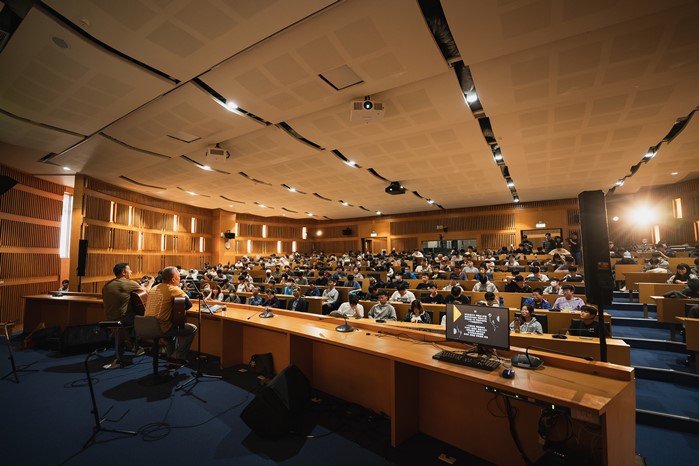
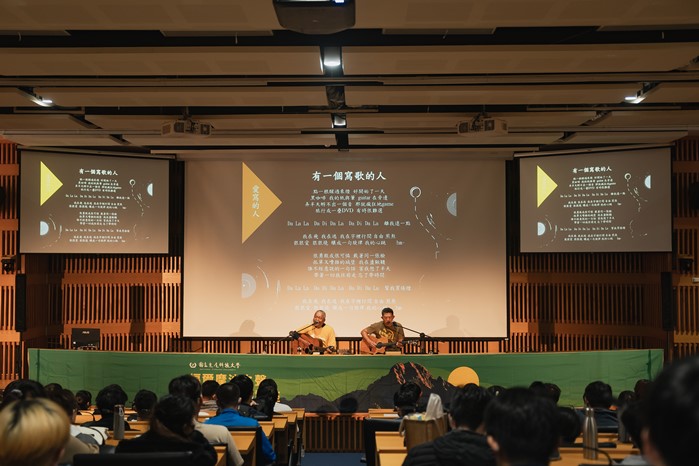
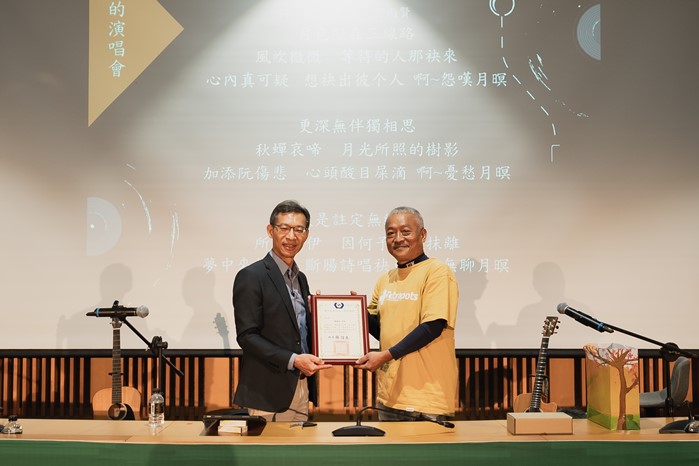
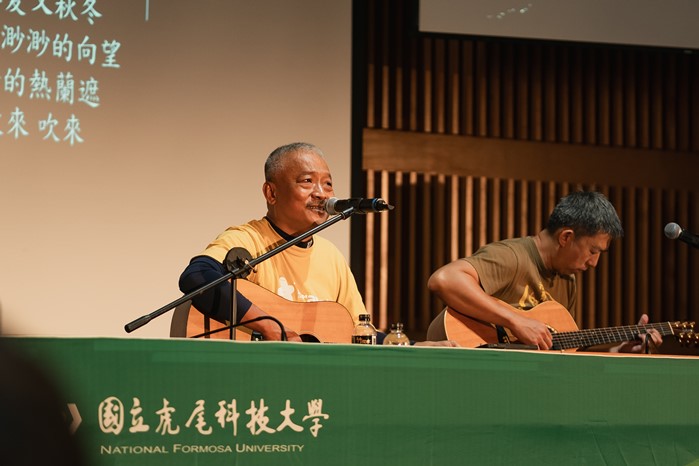
On December 1, National Formosa University (NFU) held the "Voice of Formosa – Indigenous Language Master Lecture," inviting award-winning Taiwanese poet and singer Hsieh Ming-You, along with guitarist Wang Dong-Sheng, to perform. Hsieh presented "There is a Songwriter," connecting eight songs to life experiences and city memories while sharing insights into songwriting and storytelling techniques.
Hsieh Ming-You, a veteran creator recognized with multiple Golden Melody Awards and Golden Indie Music Awards, has written popular songs for singers including Andy Lau, Anita Mui, and Vivian Hsu. In recent years, he has devoted himself to promoting mother-tongue music creation. His works are celebrated for their poetic elegance, earning him the title of "Taiwanese Poet-Singer."
Hsieh emphasized that emotions are the core theme of his works, while settings play a key role in conveying those emotions. For instance, in his hometown of Tainan, he spent half a year walking every street, experiencing familiar places in new ways, which inspired the song "Xing" (Journey).
Using the song "Siang" (Thinking) as an example, he shared how he adopts an outsider’s perspective and a third-person viewpoint in his creation, encouraging students to observe and experience their surroundings with a fresh perspective. In the song "Chiu" (Swimming), he wishes that those who write can immerse themselves in inspiration daily, never resting, always with songs to sing.
The song "Lian Lian Da Yuan" incorporates the historical "Fort Zeelandia," built during Dutch colonization over 400 years ago, reflecting his grandmother’s emotions as she awaited his grandfather, who was conscripted during Japanese rule. "Xiapu’s Waltz" depicts his mother listening to the radio and hanging laundry in the afternoon while his father dances with her in the sunlight, highlighting ordinary happiness.
Beyond personal and family stories, Hsieh explored rural areas, collecting elders’ life memories. He uses music and creation to serve and document their stories. In performing "Pian Nan Feng" (Southern Wind), he portrays the lives of island laborers and the complex, sometimes contradictory character of Taiwanese people shaped by geography, climate, and history.
For the finale, he sang the 1932 Taiwanese classic "Moonlit Sorrow," discussing how composer Deng Yu-Xian integrated classical, modern, and popular Japanese musical influences into Taiwanese songs that still carried elements of Nanguan and opera styles, creating a new linguistic and melodic style. Through the discussion of "New Taiwanese Songs," he encouraged students to "write humbly and sincerely what moves you" and emphasized that "the essence of creation is simply to move others, nothing more."
Photos courtesy of the Language Teaching Center